
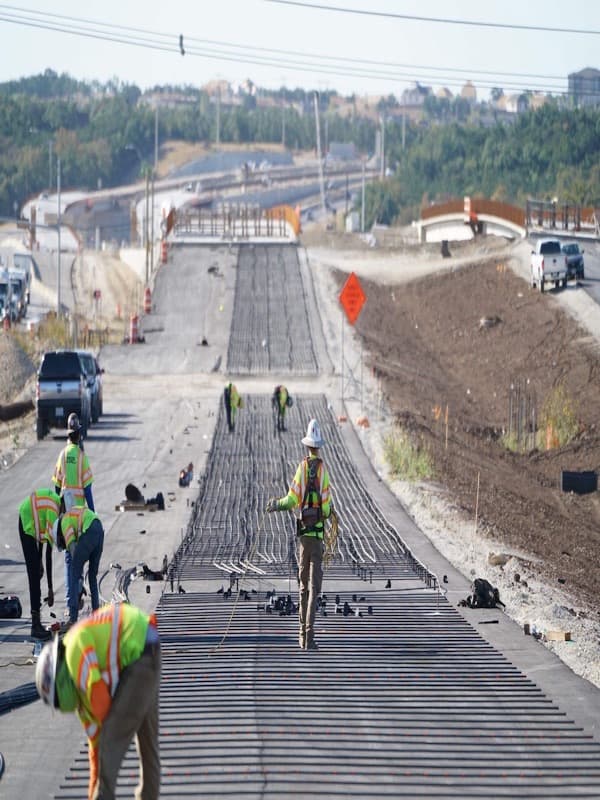
Streets and Sidewalks in Texas
Municipal and commercial sidewalk and street construction
Concrete is the material of choice for commercial streets and sidewalks in Texas because it withstands the combination of heat, heavy axle loads, and moisture that asphalt handles poorly without regular maintenance. Municipal and TxDOT concrete pavement standards in Texas typically specify 6- to 8-inch reinforced concrete for streets and fire lanes, 4- to 5-inch concrete for sidewalks and shared-use paths, with a compacted aggregate base and properly placed contraction joints at 15-foot maximum spacing. We meet or exceed those specifications and back every pour with concrete cylinder break records to document strength compliance.
Sidewalk and pedestrian infrastructure design in Texas must meet the ADA 2010 Standards and the Texas Accessibility Standards (TAS), which are administered by the Texas Department of Licensing and Regulation (TDLR) for commercial projects. TAS requires TDLR plan review and inspection for most commercial sidewalk, ramp, and accessible route construction — a process that runs parallel to the local building permit and that we manage as part of our permitting scope. Curb ramp designs that comply with both ADA and TAS standards, detectable warning surfaces, and accessible route continuity from parking to building entry are not optional amenities; they are enforceable legal requirements that we build to from the design stage rather than retrofitting at final inspection.
TxDOT driveway and sidewalk standards apply whenever street or sidewalk work occurs in a state highway right-of-way. Street pavement widths, driveway throat lengths, corner radii, sight distance triangles, and sidewalk setbacks must conform to TxDOT's Access Management Manual and relevant standard specifications. We obtain TxDOT encroachment permits for work in the ROW and coordinate traffic control plans required for work adjacent to state highways — a requirement that many smaller contractors underestimate in both cost and lead time.
What's Included
- •TxDOT encroachment and access permit coordination for ROW work
- •TDLR Texas Accessibility Standards plan submission and inspection coordination
- •Subgrade preparation and compaction testing for streets and sidewalks
- •Aggregate base installation and documentation
- •Concrete placement with cylinder break and slump documentation
- •Curb and gutter installation and integration
- •ADA/TAS-compliant curb ramp construction with detectable warning surfaces
- •Control joint and expansion joint installation
- •Municipal public works inspections and final acceptance coordination
Frequently Asked Questions
What concrete specifications apply to commercial streets and fire lanes in Texas?
Commercial streets and fire lanes in Texas are typically designed to either municipal public works standards or — for private streets on commercial developments — to the structural requirements imposed by the anticipated loading. Municipal standards in most Texas cities specify 6- to 8-inch Class C or Class H concrete (3,000 to 4,000 psi compressive strength) on 6 inches of compacted flexible base for collector streets and fire lanes. Private commercial streets carrying loaded semi-truck traffic often require 8- to 10-inch concrete with #4 or #5 rebar on 18- to 24-inch centers, or a post-tensioned design for sections crossing highly expansive clay. Fire lanes must be designed to support Fire Department apparatus — NFPA 1 requires a minimum 75,000-pound gross vehicle weight capacity — and we coordinate with the local fire marshal to confirm that the pavement section and subgrade preparation meet that requirement. We use TxDOT Item 360 concrete specifications as our quality benchmark on most commercial projects even when not technically required, because they represent well-proven practice for Texas conditions.
What are Texas Accessibility Standards (TAS) and how do they affect sidewalk construction?
Texas Accessibility Standards (TAS) are the state's accessibility requirements for commercial construction, adopted under the Texas Government Code and administered by the Texas Department of Licensing and Regulation (TDLR). TAS is substantially equivalent to the ADA 2010 Standards but has specific review and inspection requirements that go beyond the federal baseline. For commercial sidewalk construction, TAS requires that project plans be reviewed by a registered accessibility specialist before construction, that construction be inspected by a TDLR-registered inspector, and that a completed inspection form be submitted to TDLR before certificate of occupancy. TAS covers accessible route slopes (maximum 1:20 cross slope, 1:12 running slope for walks, 1:12 for ramps with handrails), surface texture (smooth and stable), detectable warning surface placement, width (44 inches minimum clear width for accessible routes), and continuity from accessible parking to each accessible entrance. We manage TAS plan submission and inspection coordination on every commercial sidewalk project in Texas.
Do commercial sidewalks and streets require permits in Texas?
Yes. Public streets require public works permits from the relevant municipality or TxDOT. Private commercial streets and fire lanes require building permits with engineered drawings. Sidewalks serving commercial buildings require building permits and TDLR TAS review and inspection. Work within TxDOT right-of-way requires an encroachment permit from the relevant TxDOT district. We manage all of these permit tracks in parallel rather than sequentially — simultaneous processing is the only way to avoid permit processing delays becoming critical path schedule items. For commercial developments with multiple permit agencies involved, we typically prepare a permit matrix at project kickoff that maps each work element to its required permit, the responsible agency, and the expected processing time.
How does TxDOT regulate sidewalk and street work adjacent to state highways in Texas?
TxDOT requires an encroachment or access permit for any construction within the state highway right-of-way, which typically extends 60 to 100 feet from the highway centerline on rural routes and varies by project on urban highways. Work within the ROW must comply with TxDOT's standard specifications and special provisions, and must be inspected by a TxDOT representative. Traffic control plans for work that affects travel lanes must be stamped by a licensed Texas PE and comply with TxDOT's Traffic Operations Manual. For sidewalks and shared-use paths within TxDOT ROW, the design must conform to TxDOT's Bicycle and Pedestrian Transportation Design Manual. We have experience navigating TxDOT permit processes across the Houston, Dallas, San Antonio, Corpus Christi, and Austin districts and understand the differences in submittals and processing times between districts.
What joint spacing and detailing do commercial construction sidewalks require in Texas?
Concrete sidewalks in Texas require contraction joints to control where cracking occurs as the concrete shrinks and as temperature changes cause expansion and contraction. Standard practice for 4-inch sidewalk panels is contraction joints at 5-foot spacing (matching panel width for square panels), cut within 24 hours of placement to 1-inch depth minimum. Expansion joints with a premolded filler are placed at building face interfaces, at curb ramps, and at regular intervals — typically every 40 to 50 feet — to allow movement without cracking. In areas subject to root uplift from existing trees, we may specify deeper cuts, crack-inducing inserts, or fiber reinforcement to minimize the crack pattern when root growth eventually lifts a panel. All joints should be sealable — we typically specify polyurethane joint sealant on ADA-designated accessible routes because joint gaps wider than 1/2 inch create a tripping hazard that violates surface condition requirements.
Common Situations
- •A commercial developer in suburban DFW needs 2,000 linear feet of private concrete street and fire lane, engineered for loaded truck traffic, with TAS-compliant curb ramps at all pedestrian crossings
- •A retail center owner in Houston needs sidewalk reconstruction along a state highway frontage, requiring TxDOT encroachment permit, traffic control plan, and TDLR accessibility inspection
- •A mixed-use developer in Austin needs 5,000 square feet of concrete sidewalk and shared-use path within a city right-of-way, coordinated with the City of Austin public works inspections and TAS compliance
Example Engagement
Service Type
Streets and Sidewalks
Scope
A mixed-use retail and residential development in suburban Houston needs 800 linear feet of private concrete collector street with concrete curb and gutter, 1,200 linear feet of ADA/TAS-compliant concrete sidewalk, and four ADA curb ramps at street intersections — all coordinated with Harris County public works, the local MUD, and TDLR TAS review.
Client Situation
The development is in an unincorporated Harris County MUD service area. The MUD has adopted county road standards requiring 7-inch concrete streets on 6-inch base. TDLR TAS review is required for all commercial sidewalk and curb ramp construction. Harris County public works must inspect and accept the street before it can be dedicated to the county.
Our Approach
We submit plans simultaneously to Harris County public works, the MUD, and TDLR, manage the review cycle for each agency, coordinate pre-pour inspections, pour street panels with documented cylinder breaks, install ADA/TAS curb ramps with compliant slopes verified by digital level, install detectable warning surfaces, and coordinate Harris County and MUD final acceptance walk-through.
Expected Outcome
A completed street and sidewalk system accepted by Harris County and the MUD, with TDLR TAS inspection completed and documented, ready for development certificate of occupancy.
Why Choose Us
Free Estimates
Get a detailed project estimate tailored to your specific needs and site conditions.
Expert Consultation
Our experienced team provides guidance on project requirements, permits, and best practices.
Quality Assurance
We ensure all work meets or exceeds local building codes and industry standards.
Thickness Guide
Related Services
Tilt Wall Construction
Efficient tilt-up concrete wall construction for commercial and industrial buildings with rapid erection and cost-effective solutions
Parking Lot Construction
Commercial parking lot design and construction
Retail Store Build Out
Complete retail store construction and fit-out services
Retail Construction
Retail construction and development projects