
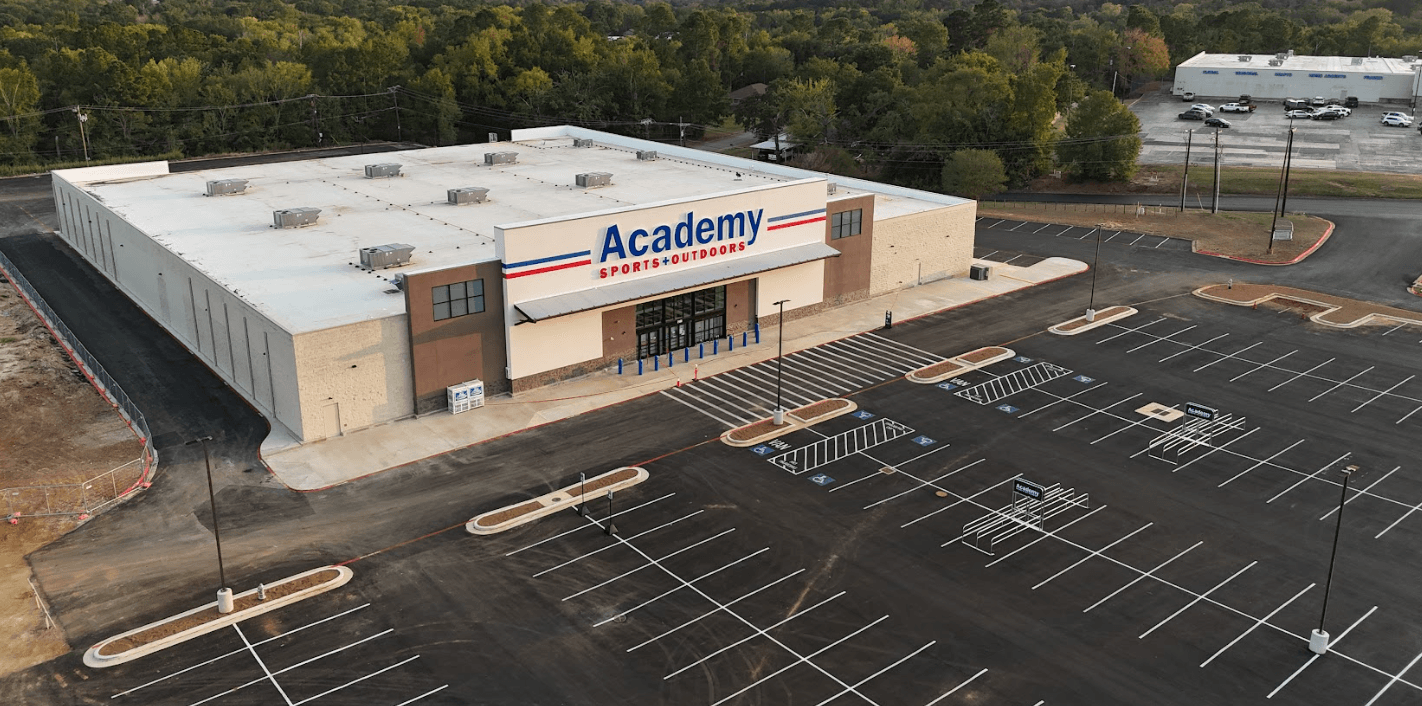
Parking Lot Construction in Texas
Commercial parking lot design and construction
Concrete parking lots are our first recommendation for commercial applications where long-term cost, durability, and reduced maintenance are priorities. Properly designed and built concrete — 5- to 6-inch unreinforced or 4- to 5-inch post-tensioned slab with a compacted aggregate base — will outlast asphalt alternatives by 15 to 20 years in Texas conditions and does not soften in 105-degree summer heat the way asphalt can under parked 18-wheelers. We design concrete parking lots to ACI 330 (Guide for the Design and Construction of Concrete Parking Lots), including joint layout to control cracking, drainage slope to move water to collection points efficiently, and perimeter curb and gutter to contain the pavement section.
Asphalt parking lots are the cost-effective choice for phased development projects, properties where future expansion is likely, and sites where the owner prefers a lower initial capital outlay with a planned maintenance program. We design asphalt sections for the actual traffic loading — light automobile traffic requires different base thickness and asphalt depth than a truck-dominated industrial parking lot — and we install drainage systems that prevent the ponding that accelerates asphalt deterioration in the Houston wet season or the DFW spring storm cycle.
Post-Harvey FEMA requirements and Houston-Galveston MUD and Harris County Flood Control District detention rules have made stormwater management an integral part of parking lot design in Southeast Texas. Large impervious surfaces must include detention — whether surface detention in bermed areas, underground detention vault systems, or porous pavement sections that reduce peak runoff — and we coordinate the civil drainage design with the pavement design so that pavement sections, drainage grades, and detention infrastructure work together rather than being designed independently. TxDOT driveway access permits are required for any parking lot that connects to a state highway, and we manage that process from permit application through final inspection.
What's Included
- •Pavement design analysis for traffic loading and subgrade conditions
- •TxDOT Access Management permit coordination for state highway connections
- •Subgrade preparation and compaction testing at each lift
- •Flexible base installation and compaction documentation
- •Concrete or asphalt pavement installation per design specifications
- •ADA-compliant accessible parking space layout and slope verification
- •Drainage system installation including catch basins, inlets, and storm sewer
- •HCFCD and Houston-Galveston MUD detention coordination on Southeast Texas projects
- •Pavement marking, striping, and signage installation
Frequently Asked Questions
Should I use concrete or asphalt for a commercial parking lot in Texas?
The honest answer is that it depends on your priorities and your site. Concrete has a higher upfront cost — typically 20 to 40 percent more than asphalt — but it lasts 30 to 40 years with minimal maintenance, does not rut under heavy loads or soften in Texas summer heat, and avoids the recurring cost of sealcoating and resurfacing that asphalt requires every few years. Asphalt has lower first cost, faster installation, and is easier to patch and resurface in sections. For a distribution center or industrial site with heavy truck traffic, we almost always recommend concrete — asphalt simply does not hold up under repetitive loaded semi-trailer traffic in Texas heat. For a retail center with primarily car traffic and an owner who prefers lower initial capital, well-designed asphalt with a planned maintenance program is a reasonable choice. We will give you an honest assessment based on your traffic loads, budget, and maintenance philosophy rather than defaulting to one material.
What base thickness is required for commercial parking lots in Texas?
Base thickness in Texas commercial parking lots is driven by the pavement design, which considers the subgrade soil's resilient modulus (essentially its stiffness), the traffic loading in equivalent single-axle loads, and the design life of the pavement. On Houston-area clay soils, where the native subgrade has low stiffness, we typically design for 8 to 12 inches of compacted flexible base (crushed limestone or crushed concrete) under concrete, or 12 to 16 inches under asphalt, to distribute loads and prevent pumping of fine clay particles into the base course. On San Antonio caliche or West Texas soils with naturally higher stiffness, base requirements can be lower. We use the TxDOT pavement design methodology or the Portland Cement Association design approach depending on pavement type, and we document compaction testing at each base lift to confirm design assumptions are met.
What drainage requirements apply to commercial parking lots in Texas?
Texas commercial parking lots must drain to prevent ponding — standing water accelerates pavement deterioration, creates liability hazards, and in Houston-area projects may trigger HCFCD or MUD detention requirements. Minimum slope for concrete is typically 1 percent (1/8 inch per foot) and for asphalt 1.5 to 2 percent to account for surface irregularity. Drainage must be directed to catch basins or curb inlets connected to the site's storm sewer system, and the storm sewer must be sized for the design storm event — typically a 10-year or 25-year frequency storm for commercial applications. In Harris County and the Houston-Galveston MUD service areas, any project that increases impervious cover above a threshold (often 5,000 square feet of new impervious cover triggers review) requires a detention analysis and may require detention infrastructure. We design the pavement drainage as part of the overall site civil work, not as an afterthought after the parking lot geometry is set.
What ADA accessibility requirements apply to commercial parking lots in Texas?
Commercial parking lots in Texas must comply with ADA 2010 Standards for Accessible Design, which establish minimum requirements for accessible parking space count (based on total spaces), space dimensions (8 feet wide minimum for standard accessible, 8 feet minimum plus 8-foot access aisle for van-accessible), surface slope (no steeper than 1:48 in any direction across the parking space), and accessible route from accessible spaces to the building entrance. Texas state law and many municipal codes add requirements beyond the federal ADA minimums. We design accessible parking spaces and routes into the parking lot layout from the beginning — not as an overlay on a completed design — and we verify slopes with a digital level during construction before the pavement is complete so that any corrections can be made before permanent markings are applied.
How do TxDOT driveway access permits work for commercial parking lots in Texas?
Any commercial parking lot driveway that connects to a state highway maintained by TxDOT requires a TxDOT Access Management permit from the relevant district office. The process involves submitting a traffic impact analysis if the driveway will generate more than the threshold trip count, engineering drawings showing the driveway design in conformance with TxDOT Access Management Manual standards (throat width, corner clearance, sight distance, curb return radii), and a bond or insurance certificate. TxDOT reviews the submittal, may require modifications to driveway geometry or traffic control measures, and issues a permit when satisfied. Processing time ranges from 30 to 90 days depending on the district and complexity. We manage TxDOT submittals as part of our permitting scope and factor the processing time into the project schedule so it does not become a critical path delay.
What does HCFCD detention compliance mean for parking lot projects in Harris County?
Harris County Flood Control District (HCFCD) rules require that new development in unincorporated Harris County and many incorporated cities with equivalent ordinances must not increase peak runoff from a site above the pre-development rate for design storm events (typically the 100-year storm). Adding a parking lot — which is impervious cover — increases peak runoff, so projects above the impervious cover threshold must provide on-site detention. Detention can be surface detention in a bermed pond, underground detention in pre-cast or cast-in-place concrete or corrugated metal vault systems, or in some cases permeable pavement that reduces runoff volume. The civil engineer designs the detention system; we coordinate the parking lot grading and drainage so that lot drainage outlets connect properly to the detention system inlet structures. We have built parking lots with all three detention approaches on Harris County commercial projects.
Common Situations
- •A logistics developer near the Port of Houston needs a 400-space concrete truck parking lot designed for loaded 80,000-pound GVW semi-trailer traffic on soft clay subgrade, with HCFCD detention coordination
- •A retail center developer in suburban DFW needs a 600-space asphalt parking lot with concrete curb and gutter, storm sewer system, and TxDOT access permit for the state highway driveway
- •A medical campus developer in San Antonio needs a structured concrete parking lot with ADA compliance, ERCOT-ready EV charging conduit, and integration with an existing underground stormwater detention system
Example Engagement
Service Type
Parking Lot Construction
Scope
A regional retail center in Northwest Houston needs a 550-space concrete parking lot on soft clay subgrade, with storm sewer system, HCFCD-compliant underground detention, ADA-compliant accessible parking, and a TxDOT access permit for the US-290 driveway.
Client Situation
The site is in unincorporated Harris County with clay soils requiring 10 inches of lime-treated subgrade and crushed stone base under concrete. The civil engineer has designed an underground detention vault system to meet HCFCD rules. TxDOT requires a traffic study and driveway permit for the US-290 connection.
Our Approach
We coordinate the TxDOT permit submission, prepare the subgrade with lime treatment and compaction testing, install the aggregate base, pour concrete pavement in panels with proper joint layout, install catch basins and storm sewer connecting to the detention vault, verify accessible parking slopes with digital level before striping, and complete striping and signage.
Expected Outcome
A completed 550-space concrete parking lot with proper drainage to HCFCD-compliant detention, ADA-compliant accessible spaces, and a TxDOT-permitted driveway connection, delivered on schedule for retail center opening.
Why Choose Us
Free Estimates
Get a detailed project estimate tailored to your specific needs and site conditions.
Expert Consultation
Our experienced team provides guidance on project requirements, permits, and best practices.
Quality Assurance
We ensure all work meets or exceeds local building codes and industry standards.
Thickness Guide
Related Services
Tilt Wall Construction
Efficient tilt-up concrete wall construction for commercial and industrial buildings with rapid erection and cost-effective solutions
Streets and Sidewalks
Municipal and commercial sidewalk and street construction
Retail Store Build Out
Complete retail store construction and fit-out services
Retail Construction
Retail construction and development projects