
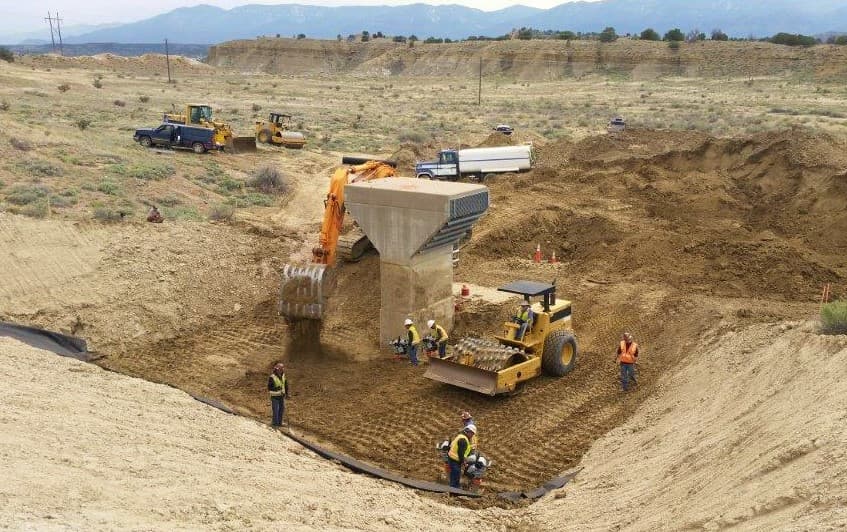
Earthwork in Texas
Site preparation and earthwork services
At Inner Loop Construction our earthwork scope typically runs from site clearing through subgrade preparation and compaction verification, coordinated tightly with the foundation and site drainage scopes that follow. We are the general contractor of record on most of our industrial and commercial projects, which means we own the sequencing risk: if our earthwork doesn't hit specified compaction and grade tolerances, we're the ones who absorb the cost of foundation rework. That accountability is what drives our discipline around compaction testing and grade verification — we're not subcontracting earthwork and walking away from the results.
On Blackland Prairie sites in the Dallas-Fort Worth Metroplex and through the Waco corridor, expansive clay soil (PI greater than 40 in many locations) requires lime or cement stabilization of the upper subgrade before any structural fill or slab goes in. We coordinate with the geotechnical engineer on stabilization depth and treatment percentage — typically 3 to 6 percent lime by dry weight for PI reduction to the 20s — and we verify with Atterberg limit testing before we allow the concrete crew to set forms. Skipping this step on Blackland clay is how you get slab settlement and differential heave that shows up as cracked warehouse floors and sticking dock doors 18 months after opening.
In the greater Houston area, Beaumont clay and the associated high water tables require a different approach. Cut slopes must be managed carefully during wet-weather grading to prevent slope failures and sloughing into excavations. Fill placement must be staged in thin lifts — typically 8 inches compacted loose thickness — with moisture conditioning to within 2 percent of optimum moisture content before compaction. On post-Harvey FEMA flood elevation projects, building pad elevations are often driven by BFE (base flood elevation) plus freeboard requirements, which can require significant engineered fill placement and compaction that adds project cost but is non-negotiable for flood insurance and permitting purposes.
West Texas earthwork on caliche and rocky terrain presents equipment challenges: hardpan caliche that standard scrapers and push-dozers can't penetrate without ripping, and subsurface rock that requires blasting or hydraulic hammering to break for utility trenches. We assess ripping feasibility versus mass excavation for caliche removal and involve the geotechnical engineer in rock characterization when percussion drilling indicates hard rock at depth. On sites where blasting is used we coordinate with the county and notify adjacent landowners — Texas property law and county regulations govern blast notification requirements that vary by jurisdiction.
Drainage design runs parallel to our earthwork execution. Positive grade away from building pads is the minimum, but Texas commercial sites also need to manage the drainage patterns created by cut-and-fill operations to avoid concentrating runoff in ways that weren't anticipated in the civil engineering design. We maintain close coordination with the civil engineer of record through every grade change, particularly on sites where the drainage area upslope of the project is larger than the project itself — common in urban infill locations in Houston and San Antonio where upstream paving has increased runoff concentration over the decades.
What's Included
- •Geotechnical report review and earthwork plan coordination
- •TPDES stormwater permit coordination and SWPPP preparation
- •Site clearing: vegetation removal, stump grubbing, and demolition coordination
- •Cut and fill operations with lift-by-lift compaction testing
- •Subgrade lime or cement stabilization for expansive clay sites
- •Rough grading to civil plan elevations and drainage slopes
- •Building pad preparation to geotechnical specified subgrade
- •Erosion and sediment control: silt fence, inlet protection, construction entrance
- •Coordination with civil engineer on drainage patterns and grade verification
- •Fine grading and subgrade proof-roll before concrete operations
Frequently Asked Questions
How do you handle Blackland Prairie clay soils in DFW and Central Texas earthwork?
Blackland Prairie clay has plasticity indices often exceeding 40, meaning it will shrink and swell dramatically with moisture changes. We require geotechnical-specified lime or cement stabilization of the upper subgrade before structural fill placement. We perform Atterberg limit testing before and after stabilization to confirm the treatment has reduced PI to acceptable levels. Failure to stabilize these soils is the root cause of most commercial slab heave and settlement in the DFW and Waco markets.
How do you address FEMA flood elevation requirements on Houston-area earthwork projects?
Post-Harvey FEMA map revisions have raised BFE (base flood elevation) requirements across much of the greater Houston area. Building pads must be placed at or above BFE plus any local freeboard requirement. We work from the FEMA FIRM panel and the civil engineer's grade-to-BFE calculations to establish target fill elevations, then execute fill placement in lifts with compaction testing at each lift. Elevation certificates are required at construction completion and we coordinate that process with the civil engineer.
What permits are required for earthwork in Texas?
Most commercial earthwork in Texas requires a grading and drainage permit from the local municipality or county. In areas with stormwater permit requirements (typically sites over 1 acre that disturb soil), a TPDES (Texas Pollutant Discharge Elimination System) stormwater permit is required from TCEQ. We prepare the Stormwater Pollution Prevention Plan (SWPPP) and install BMP (best management practice) controls including silt fence, inlet protection, and stabilized construction entrances before earthwork begins.
How do you handle caliche hardpan and subsurface rock in West Texas?
Caliche hardpan ranges from rippable to effectively rock-hard depending on age and calcium carbonate content. We assess ripping feasibility with a D9 or D11 dozer before committing to an excavation approach. If ripping fails we move to hydraulic hammer on an excavator for localized hard spots, or blasting for mass rock removal — which requires coordination with county and adjacent landowners per Texas regulations. We include a contingency in our earthwork pricing for rock encountered beyond what test borings indicated.
Do you self-perform earthwork or subcontract it?
We self-perform most earthwork on our commercial and industrial GC projects in the Houston metro and Southeast Texas using our own equipment fleet. On West Texas and Panhandle projects we partner with established regional earthwork contractors who know the local terrain, caliche conditions, and water table characteristics, while our superintendent remains on-site for quality and schedule oversight. Either way, earthwork quality is our responsibility as GC.
Common Situations
- •A developer in Waco's Blackland Prairie needs site grading and lime stabilization for a 15-acre logistics facility pad, including fill placement to achieve FEMA BFE plus two feet of freeboard before foundation pour
- •A Permian Basin industrial client needs a caliche hardpan site ripped and graded for a stabilized equipment laydown yard, with utility trench excavation requiring hydraulic hammer for caliche sections deeper than 4 feet
- •A suburban Houston commercial developer needs fill placement and compaction to raise a building pad 3.5 feet above existing grade to meet post-Harvey FEMA flood elevation requirements
Example Engagement
Service Type
Commercial Earthwork and Site Grading
Scope
Full earthwork package for a 12-acre industrial facility site including clearing, SWPPP installation, lime stabilization of upper 12 inches of Blackland clay subgrade, engineered fill placement to building pad elevation, compaction testing at each 8-inch lift, and fine grading to civil plan before foundation mobilization
Client Situation
A manufacturing developer needed a fast-track site ready for foundation work in 6 weeks. The geotechnical report revealed PI-42 clay requiring lime treatment, and the site needed 2.5 feet of fill to reach building pad elevation above the 100-year flood event plus freeboard.
Our Approach
We mobilized a lime stabilization contractor the same week as site clearing, performed sequential lift-by-lift compaction testing, and maintained continuous communication with the civil engineer on grade verification. SWPPP controls were installed before any soil disturbance to satisfy the TPDES permit requirement.
Expected Outcome
Building pad delivered at specified elevation with compaction testing documentation confirming 95 percent Modified Proctor density at each lift, ready for foundation work on schedule.
Why Choose Us
Free Estimates
Get a detailed project estimate tailored to your specific needs and site conditions.
Expert Consultation
Our experienced team provides guidance on project requirements, permits, and best practices.
Quality Assurance
We ensure all work meets or exceeds local building codes and industry standards.
Thickness Guide
Related Services
Commercial Asphalt Parking Lots
Commercial asphalt parking lot construction
Asphalt Repair and Resurfacing
Asphalt surface repair and resurfacing services
Asphalt Sealcoating
Asphalt sealcoating and protective coating services
Site Preparation
Construction site preparation and grading